ABCDE Framework
The ABCDE framework breaks down the disinformation problem into smaller operative factors that can be framed as questions. It can be used to give structure to reports of any length and outline available data in a clear and coherent manner. The ABCDE approach sets a standard that can be tailored to the needs of individual institutions or teams. For more information about the framework, click here.
Where ABCDE comes from
ABCDE took shape in four published steps, from a three-letter model in 2019 to the framework the EU's diplomatic service uses in its threat reports.

September 2019: the ABC. Camille François wrote "Actors, Behaviors, Content: A Disinformation ABC" for the Transatlantic Working Group on Content Moderation Online and Freedom of Expression. It set out three features of viral deception to guide regulators and industry while limiting the impact on freedom of expression.
April 2020: a D for distribution. Alexandre Alaphilippe of EU DisinfoLab argued in a Brookings article that "the ABC framework should be expanded to include a 'D,' for information Distribution". His D is a separate proposal, not the D in ABCDE.
September 2020: ABCDE. James Pamment set out the five-part framework in a paper for the Carnegie Endowment for International Peace. The strategic communications division of the EU's diplomatic service, the EEAS, commissioned the series, and Pamment prepared it independently.
In his version, D stands for degree, which covers "the distribution of the content in question and the audiences it reaches", and E for effect. The paper lists the work it adapts, including François's ABC and Alaphilippe's proposal.
February 2023: the EEAS adopts it. The EEAS's first FIMI threat report presents Pamment's ABCDE framework, "Building on Camille François's ideas", as a way to tell FIMI incidents apart by actors, behaviours, content, degree and effect.
Its second report bases its method on standard frameworks such as ABCDE, and its third report builds its FIMI Exposure Matrix on the actor part of ABCDE.
The five questions in our investigations
Several of our FIMI investigations are set out in A–E sections, including the Sprinter network, the Belarusian Silovik channel, the Doppelganger journalist case and the first Operation Overload report.
In the Doppelganger journalist case, the report says, the "Debunk.ORG team used ABCDE framework and DISARM TTPs to describe the FIMI operation". Pamment's paper gives the aim of each part; the first Operation Overload report, on the fake verification requests sent to us, shows each part in a few lines.
Actor
The actor part asks which kinds of actors produce and engage with the suspected disinformation, and the paper adds: "This is not always easy to discern." In the Operation Overload report, the actors appear to be individuals or groups mostly using Gmail accounts to send emails. The section describes what the evidence shows and stops there.
Behaviour
The behaviour part asks how far deception or other illegitimate communication techniques are part of the case. In our report, that meant "the systematic sending of e-mails to Debunk.org, particularly during significant dates, to overwhelm and distract the team". This is the part where the techniques are named, as the section on DISARM below explains.
Content
The content part examines the information used in the case. The emails in our report carried disinformation about "the Ukrainian military and government", political allegations, social issues and security threats.
Degree
The degree part covers how far the content spread and which audiences it reached. Our report judged the impact "significant", because the emails diverted our resources from genuine disinformation events to debunking targeted false content.
Effect
The effect part uses impact indicators to judge how much of a threat a case poses. Our report found that the email campaigns led to "decreased efficiency in Debunk's primary mission".
A worked example: the Sprinter network
Our investigation of the Sprinter network on X, published in May 2025, sets out the case in five sections, A to E, and places its list of DISARM techniques straight after the behaviour section.

On the actor, the accounts' X IDs showed that the many handles and names belonged to only two accounts. Content shared with a Belarusian Telegram channel "points to the potential involvement of Belarusian state actors in the network's operations".
On behaviour, data from SocialBlade and from the accounts' posts showed evidence of purchased followers, with daily post counts from 140 to 533. The DISARM list that follows names techniques such as "T0128.005: Change Names of Accounts".
On content, we logged more than 30 misleading posts during the research. On degree, Meltwater, a social media tracking tool, reported "6.06 million mentions and 4.62 million reposts annually".
On effect, the report says it is hard to judge the network's effect on public perception, but concludes that X often suspended the accounts for exceeding their hourly posting limits, so their operators kept changing usernames to stay active.
Read in order, the five parts show the shape of the case: two accounts posing as a network, inauthentic posting at scale, misleading content, wide reach and an operation kept alive by renaming. The actor section stays at "potential involvement", because that is as far as the evidence goes.
How analysts use ABCDE
The EEAS describes ABCDE as a checklist for complete analysis: it makes analysts ask comprehensive questions about a threat actor's activity. Its first threat report calls it "a helpful mnemonic for both investigators and readers".
Its second report puts the framework into a working sequence: analysts answer the ABCDE questions while they collect evidence, then encode the results in STIX, a standard data format. The same report adds that ABCDE covers what the technical analysis of techniques leaves out, "such as narratives, nature of the threat actor, triggering events or types of targets".
The third report extends the actor part, with a common model that sorts sources by how closely they are connected to a threat actor. Academic work refers to the framework too: a 2025 research preprint on influence operations notes that ABCDE "assists EU institutions and platforms in identifying key operational components".
ABCDE, DISARM and STIX: one inside the other
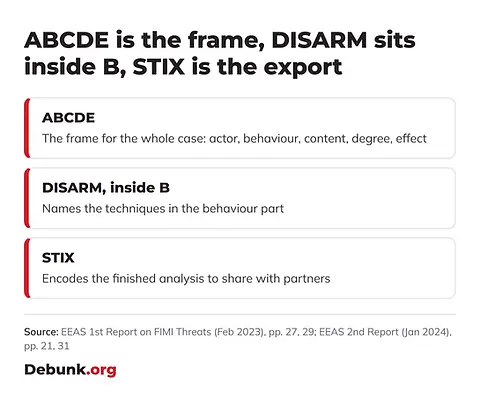
The three work together rather than as alternatives: ABCDE is the frame for the whole case; DISARM is how the behaviour part is described; STIX is how the finished analysis is shared.
The EEAS's first threat report says DISARM helps "to operationalise the "B" in the ABCDE framework", the part it treats as first among equals. In the Sprinter report, the DISARM codes sit in exactly that place, between behaviour and content. Our DISARM framework guide explains the codes.
STIX comes in at the end, when the analysis is shared. The first report proposes threat indicators inspired by STIX, a cybersecurity data format for standardising information on threat actors' behaviour and infrastructure. The second report sums up the sequence: organise the information by ABCDE, encode it with taxonomies and STIX, and share it with partners.
Our STIX for FIMI page explains the format.
How to use ABCDE yourself
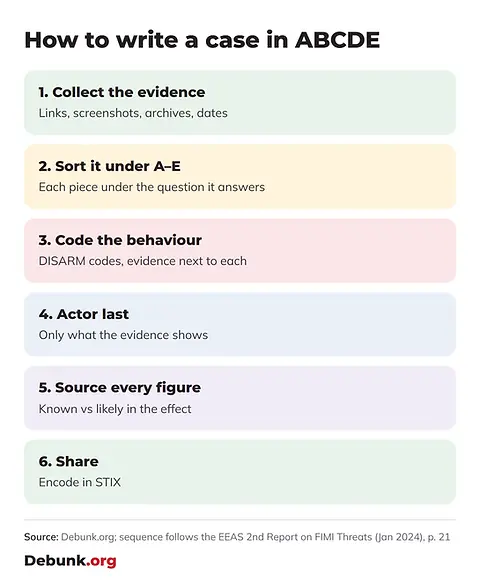
ABCDE needs no software: it is a set of headings that works for a short note as well as a long investigation.
-
Collect the evidence first: links, screenshots, archived copies, dates.
-
Sort each piece of evidence under the question it answers. Who runs an account is actor evidence; posting volume and renamed accounts are behaviour; the posts themselves are content; mentions and reposts are degree.
-
Describe the behaviour with DISARM codes where a technique fits, and keep the evidence next to each code.
-
Write the actor section last, and only from what the evidence shows.
-
Give every figure its source and its limits, and in the effect section separate what is known from what is likely.
-
To share the result with other organisations, encode it in STIX.
The same headings work for checking someone else's report: if a report names an actor without evidence, or gives a reach figure without a source, the gap shows at once.
What ABCDE does not do
ABCDE organises evidence; it does not produce it. A report is only as strong as the data under each heading, and the framework cannot settle who is behind an operation when the evidence does not. It gives no shared codes of its own either: two analysts can describe the same behaviour in different words, which is why the behaviour part is described with DISARM codes.
FIMI 101 is a 10-hour, self-paced online course with the skills and practical tools to recognise, analyse and counter FIMI campaigns. Start FIMI 101 →
Frequently asked questions
What does ABCDE stand for?
Actor, behaviour, content, degree and effect: five questions about who is involved, how they act, what they spread, how far it reached and what impact it had.
Who created the ABCDE framework?
James Pamment set it out in a paper for the Carnegie Endowment for International Peace in September 2020, as part of a series commissioned by the EEAS. He adapted it from earlier work, including Camille François's "ABC" of actors, behaviours and content and Alexandre Alaphilippe's proposal to add a D for distribution.
How do ABCDE and DISARM fit together?
ABCDE is the frame for the whole case. DISARM sits inside it, in the behaviour part, where its codes name the techniques; the EEAS calls DISARM a taxonomy that helps "to operationalise the "B" in the ABCDE framework".
Who uses the ABCDE framework?
The EEAS uses it in its FIMI threat reports, from the first report in February 2023 onwards, and we use it in our own investigations.
Does ABCDE require the actor to be identified?
No. The actor section records what the evidence shows. Pamment's paper says of actors: "This is not always easy to discern."
Our Reports with ABCDE Framework


Explore the Components of FIMI
A deeper understanding of Foreign Information Manipulation and Interference (FIMI) can be achieved by exploring its core elements. Each framework is a critical piece of our strategy against disinformation. Click on each to discover how they drive our collective efforts.