As the Stands on 9 May Thins, Kremlin Mouthpieces Pour Anger at the Baltic States

The principled decision by Lithuania and its Baltic neighbours to deny the Slovak leader’s flight through their airspace to the Victory Day commemoration in Moscow for the second year in a row has sparked a storm of reaction in pro-Kremlin media. According to our study, this year has once again seen the repetition of lies about the alleged desecration of Soviet soldiers’ graves, the persecution of Russian speakers, the rewriting of history, and the resurgence of Nazism not only in the Baltic states but also in many European countries.
Many political experts agree that the significance of 9 May in today’s Russia extends far beyond historical memory.
Putin’s regime has taken over the myth of the Kremlin’s imperial triumph, created back in the Brezhnev era, and turned it into a kind of social contract: obedience in exchange for the promise of greatness and the revival of the empire. However, every year it becomes increasingly difficult to reconcile this narrative with reality — the war in Ukraine is bogged down, and signs of economic decline are becoming ever more evident. The pomp of the parade is intended to mask what the Kremlin refuses to acknowledge.
Due to political developments in Europe that are unfavourable to the Kremlin, Slovak Prime Minister Robert Fico’s visit to Moscow this year has taken on greater significance in Russian propaganda than it did last year.
A year ago, Serbian President Aleksandar Vučić travelled to Moscow alongside Fico, but this year he changed his mind — more precisely, he traded friendship with the Kremlin for EU financial aid. Furthermore, Viktor Orbán, a longtime friend of the Kremlin, lost power this year. Therefore, the symbolic significance of Fico’s visit has increased significantly. Especially since the news itself about the Baltic states’ ban on using their airspace to travel to Moscow for Victory Day was announced as early as 18 April, more than a week before the analysed period.
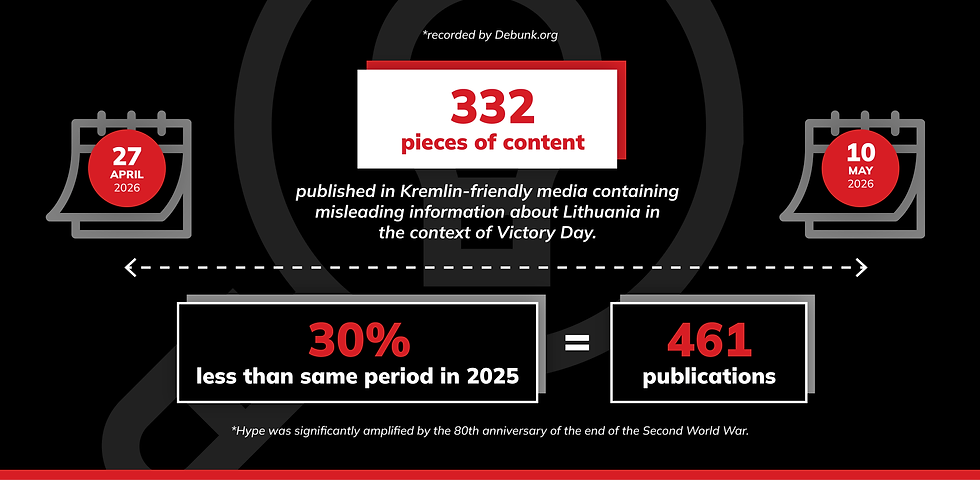
According to an analysis by Debunk.org, between 27 April and 10 May 2026, 332 pieces of content were published in Kremlin-friendly media containing misleading information about Lithuania in the context of Victory Day (9 May). This is nearly 30 per cent less than during the same period last year (461 publications). However, last year’s hype was significantly amplified by the 80th anniversary of the end of World War II.
The most frequently repeated narrative this year has been the lack of unity in the West. Messages opposing the Baltic states’ decision to deny airspace access have also escalated noticeably. This narrative has gained significance today. The reality of war-torn Russia increasingly contradicts the myth of an ‘invincible empire’. Therefore, there is an effort to suggest that the West is on the verge of falling apart, that its support for Ukraine will collapse, and that victory will not be long in coming — that a return to better times lies just around the corner.
The second most popular narrative — the destruction of Soviet monuments and soldiers’ graves — has received greater attention in pro-Russian media in recent years. It is often presented alongside broader claims about the allegedly hostile stance of the Baltic states and the West toward Russia.
This propaganda narrative serves as a universal mobilisation tool. It is used to delegitimise the Baltic states and reinforce the narrative of a siege — namely, that Russia is at war with an omnipresent, hostile Western world. By appealing to outrage over the alleged desecration of graves, the rewriting of history, and the persecution of Russian speakers, Moscow seeks to at least somewhat sustain the crumbling sense of social unity.
Another significant element identified in the analysis is the escalation of a classic elite-versus-the-people framing. In Kremlin media, the governments of the Baltic states and the West are portrayed as alien to their own populations — banning celebrations, persecuting dissidents, rewriting history — while ‘the people’ are depicted as an authentic force with a ‘correct’ understanding of history, merely waiting for the opportunity to cast off the elite’s yoke.
This narrative is not constructed in a vacuum — it targets a real political environment in which, amid migration challenges and social media echo chambers, extremist political forces are gaining ground across Europe. The Kremlin did not create these sentiments, but it exploits them deliberately and steers them in a direction favourable to its own ends.


Comments